
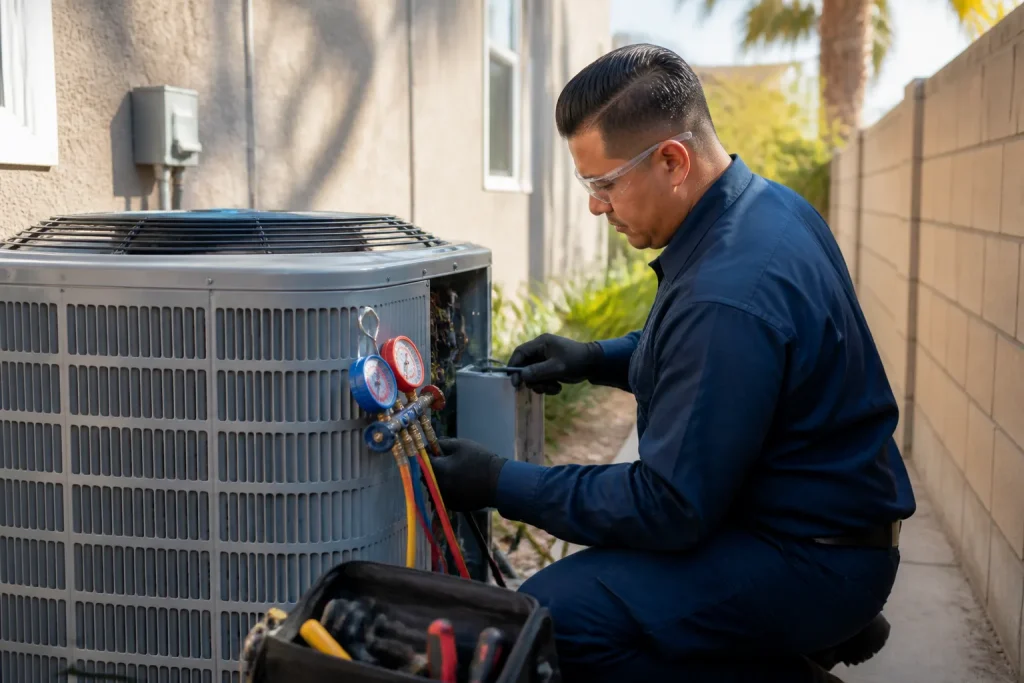
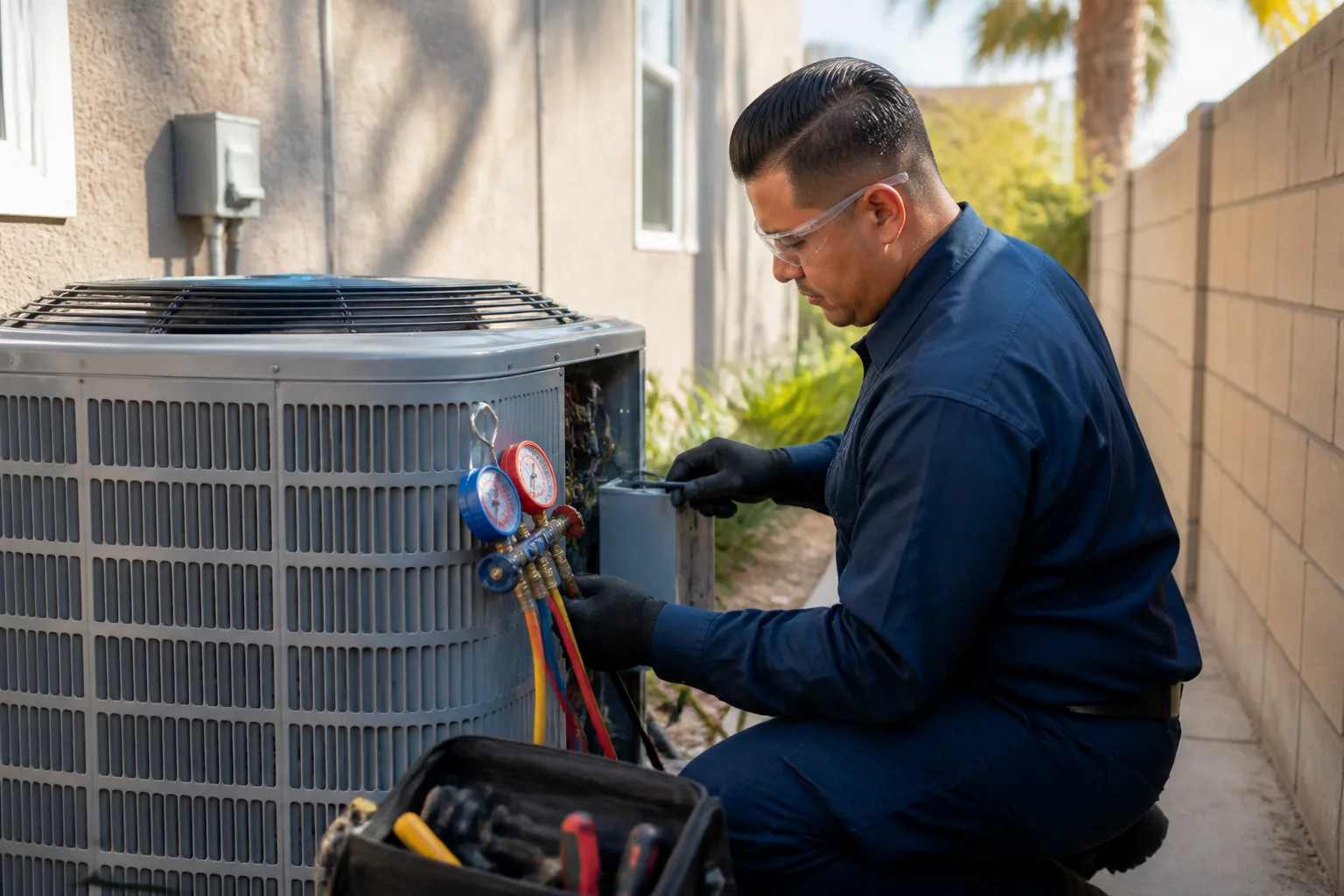
Bryant AC Repair in Downey: A Homeowner’s Guide
Most Bryant systems in Downey get serviced by someone guessing. That’s the honest version of what we see: a technician arrives, sees a familiar-looking cabinet, assumes it’s a Carrier, and quotes parts against the wrong spec sheet. Bryant and Carrier share a parent company and plenty of engineering DNA, but the warranty terms, control board part numbers, and dealer authorization structures are distinct enough that the wrong shop can misquote your repair or put your coverage at risk. This guide covers what actually matters for a Bryant system in Downey – the model tiers, the fault codes, the parts that fail, and how to keep your warranty intact.
Why Bryant Systems in Downey Need Brand-Specific Attention
Bryant sits under the same corporate roof as Carrier, and that’s both good and tricky for Downey homeowners. The good part: the underlying scroll compressors, coil designs, and cabinet architecture are shared across both lines, which means a technician who genuinely knows Carrier equipment often understands the bones of a Bryant unit too. The tricky part: the parts bins don’t fully overlap.
Control boards carry different part numbers between Bryant and Carrier models even when the physical footprint looks identical. Fan motors and blower assemblies can differ by series. And critically, Bryant’s warranty registration and transfer rules are enforced through Bryant’s own dealer network, not Carrier’s. A shop that only sells and services Carrier may not be authorized to submit a Bryant warranty claim, which is where homeowners in Downey sometimes get stuck paying out of pocket for a part that should’ve been covered.
We’re certified to service nine major brands, including Bryant and Carrier, precisely because so many Downey homes have one or the other. The neighborhoods around Downey Landing and the older tracts off Firestone Boulevard are full of builder-installed Bryant systems from the 2000s and 2010s. If a technician shows up and treats your Bryant like a generic unit, ask whether they’re actually authorized to handle Bryant warranty work. If the answer is fuzzy, that’s your answer.
See how we approach AC repair in Downey for a sense of what a proper diagnostic visit looks like.
The Bryant Model Line Breakdown: Evolution, Preferred, and Legacy
Bryant sells three main residential tiers, and each one fails in a different pattern. Knowing which series you own helps you understand what a repair quote is actually for.
- Evolution series: The top tier. Variable-speed compressors, communicating controls, and the most sophisticated boards in the lineup. When Evolution systems fail, it’s usually the communicating control board or the inverter module, not the compressor itself. These are the most expensive parts to source, and aftermarket substitutes are a bad idea on this tier. Stick with Bryant OEM.
- Preferred series: The mid-tier, and by far the most common Bryant system in Downey homes. Two-stage or single-stage compressors with more conventional controls. This is where the capacitor and contactor failure pattern shows up most, and we’ll get to that below.
- Legacy series: The entry tier. Simple single-stage equipment, basic controls, and the most forgiving platform for aftermarket parts when the OEM option is backordered. Legacy units are also the most likely to be at the point where repair versus replacement becomes a real question.
If you don’t know which series you have, look at the data plate on the outdoor condenser. The model number prefix tells you. A technician who knows Bryant can decode it in seconds and tell you which parts are shared with Carrier and which are Bryant-specific.
Common Bryant Fault Codes and What They Actually Mean
Bryant’s communicating controls – most commonly the Evolution and Preferred series with the wall-mounted thermostat – display fault codes when something’s wrong. The codes are useful, but only if you know how to read them. Here’s what the most common ones mean in plain English:
- Code 33 (or similar “limit” codes): The system is protecting itself. Usually airflow restriction – a clogged filter, blocked return, or failing blower motor. Not a refrigerant problem, despite what some homeowners assume.
- Code 34 (ignition lockout): On the furnace side of a Bryant split system, this means the control tried to ignite and failed multiple times. Could be a dirty flame sensor, gas valve issue, or pressure switch problem. This is a furnace code, not an AC code, but it shows up on the same thermostat and confuses people.
- Code 45 or “low pressure” codes: The system detected low refrigerant pressure. Could be a slow leak, a failing low-pressure switch, or undercharge from a prior service. Needs a proper leak-down test, not a quick top-off.
- Code 66 or communication faults: The indoor and outdoor units aren’t talking. Often a control board, wiring, or the communicating thermostat itself. This is where Carrier and Bryant part numbers diverge most sharply.
If your Bryant thermostat is flashing a code you don’t recognize, don’t reset it and hope. The code is stored for a reason, and clearing it wipes the diagnostic history your technician needs.
The Capacitor and Contactor Pattern in Bryant Preferred Units
This is the thing we wish more Downey homeowners knew. Bryant Preferred series condensers – the ones installed across much of Downey through the 2000s and 2010s – have a documented tendency to eat capacitors and contactors somewhere in the 7-10 year window. In a hot climate like Downey’s, where the AC runs hard from May through October, that window can come faster.
What does it look like? The condenser fan runs but the compressor won’t kick on. Or the unit tries to start, hums, and shuts off. Or the thermostat calls for cool and nothing happens at all. Nine times out of ten, a Preferred series unit in that age range with those symptoms has a failed start/run capacitor or a pitted contactor. Both are relatively inexpensive repairs compared to the alternatives, and both are worth doing properly with OEM or OEM-equivalent parts rather than whatever’s cheapest on the truck.
The catch: a failing capacitor can stress the compressor if it’s left too long. That’s when a $150-ish problem becomes a compressor replacement. If your Bryant is in that 7-10 year window and you’ve never had the electrical components checked, it’s worth a diagnostic visit before the next heat wave hits Downey.
OEM Parts vs. Aftermarket: When the Difference Actually Matters
Here’s a straight answer: on the Legacy series, aftermarket parts are usually fine. On the Preferred and Evolution tiers, they’re often a mistake.
For Legacy single-stage equipment, a generic capacitor or contactor that meets the electrical spec will do the job. The system is simple, tolerances are wide, and the OEM part number has an equivalent on the aftermarket shelf that’s functionally identical.
For Preferred two-stage systems, OEM matters more. Matching the OEM capacitance and voltage rating exactly (not “close enough”) keeps the compressor from working harder than it should. Aftermarket capacitors with slightly off specs are a known cause of premature compressor failure on this tier.
For Evolution communicating systems, aftermarket is a hard no. The control boards and inverter modules are proprietary. There is no equivalent. A shop offering a “compatible” aftermarket board for an Evolution unit is telling you they don’t work on many Evolution units.
The good news for Downey homeowners: because we service nine brands including Bryant and Carrier, we can source genuine Bryant OEM parts and explain, in plain terms, whether the aftermarket option is a reasonable choice for your specific tier or not. That’s not a sales pitch – it’s engineering. Sometimes the answer is “save your money, the aftermarket part is fine,” and we’ll say so.
When to Call a Pro
Some Bryant issues are genuinely DIY-friendly. Changing the filter, checking the outdoor disconnect, verifying the thermostat isn’t set to heat by accident – all reasonable homeowner moves. But the moment you’re dealing with the outdoor unit’s electrical components, the refrigerant circuit, or a communicating control system, that’s where it gets dangerous.
Capacitors hold a serious charge even after power is cut. Refrigerant handling requires recovery equipment and EPA certification. Control boards can be damaged by a static spark you can’t feel. We keep the safety caveat short because we mean it: if your Bryant’s problem is more than a filter or a thermostat setting, call someone trained to work on it. The repair is cheaper than an injury.
If you’re weighing repair against replacement, we’ll give you the honest math on your specific Bryant system rather than pushing new equipment. And when replacement is genuinely the right call, our AC installation process handles the load calculation and full setup.
The Bottom Line
Bryant equipment in Downey deserves a technician who knows it’s a Bryant, not a Carrier with a different badge. The shared architecture is real, but the warranty rules, part numbers, and failure patterns are distinct. If you’ve got a Preferred series unit in the 7-10 year range, get the capacitor and contactor checked before summer. If you’ve got an Evolution system with a communication fault, don’t let a generic shop swap a “compatible” board into it. And if you don’t know which series you have, that’s the first question to ask on any service call.
If you’re in Downey and need help, AC Repair Downey offers free estimates – call (855) 677-0314. We answer 24/7. Fast dispatch from 7am to 7pm, Sunday through Friday.
Frequently Asked Questions
For most Bryant factory warranties to stay intact, the work should be performed by a technician authorized to submit Bryant warranty claims. Using an unauthorized servicer doesn’t automatically void coverage, but it can create paperwork problems when a claim is filed. Always ask before the work begins. Call (855) 677-0314 for a free estimate and we can walk you through what your specific coverage likely requires.
You can, but you shouldn’t until a technician has read the code. Resetting clears the diagnostic history, which is the most useful information for diagnosing the actual problem. Note the code number and call (855) 677-0314. We answer 24/7 and can book fast dispatch from 7am to 7pm, Sunday through Friday.
Most Bryant systems in Downey’s climate run 12-15 years with regular service, sometimes longer on the Evolution tier with proper maintenance. The Preferred series tends to need its first significant electrical repair in the 7-10 year window. Beyond year 12, weigh each repair against replacement cost. Call (855) 677-0314 for a free estimate if you’re facing that decision.
On the Legacy series, usually yes. On the Preferred series, only if the electrical specs match OEM exactly. On the Evolution series, no – the communicating controls are proprietary and require Bryant parts. Ask your technician which series you have before agreeing to aftermarket parts. Call (855) 677-0314 to talk it through with a free estimate.
Related services in Downey: if you’re weighing a full system changeout, start with our AC Repair Downey overview to see how we approach both repair and replacement decisions.
Written by the team at AC Repair Downey.
Need HVAC Help?
Call AC Repair Downey - licensed & insured, here with fast help in Downey.
(855) 677-0314